Gullu
Screen Time and Creative Apps for Young Kids — What the Guidance Says
Short answer: The WHO recommends no sedentary screen time for children under 2 and no more than 1 hour a day for ages 2 to 4, with less being better. The American Academy of Pediatrics' 2026 policy moved away from fixed time limits toward quality, context and using media together. Creative apps like coloring can fit within that guidance when they are ad-light, used in short sessions, and balanced with hands-on play.
What does the WHO recommend for children under 5?
The WHO's 2019 Guidelines on physical activity, sedentary behaviour and sleep for children under 5 years of age give clear numbers:
| Age | WHO screen time guidance |
|---|---|
| Under 1 | Screen time is not recommended |
| 1 year | Sedentary screen time (such as TV, videos, computer games) is not recommended |
| 2 years | No more than 1 hour; less is better |
| 3 to 4 years | No more than 1 hour; less is better |
The WHO also says that when young children are sitting still, reading and storytelling with a caregiver are encouraged (WHO). The guidelines treat screen time as part of a bigger picture that includes plenty of active play and good sleep.
For ages 5 to 17, the WHO's 2020 guidelines advise limiting sedentary time, "particularly the amount of recreational screen time," without setting a number. The evidence summary rates this as a strong recommendation based on low-certainty evidence (Chaput et al., 2020).
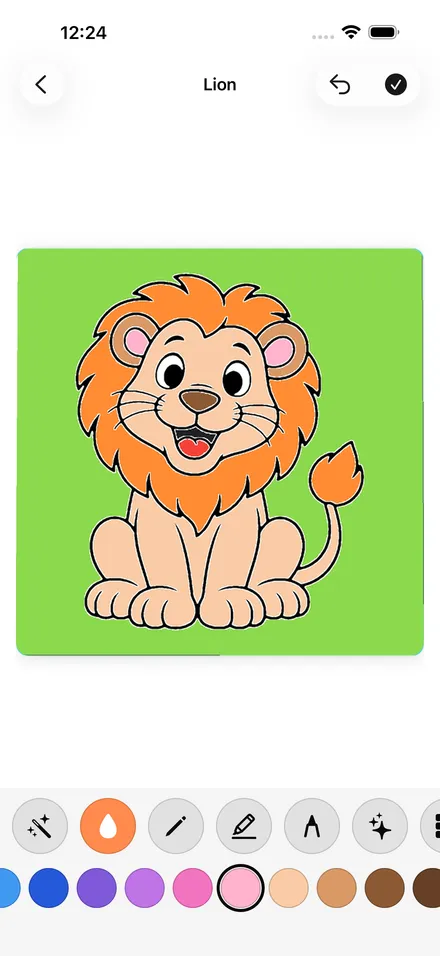
Does a coloring app count? Yes. By the WHO's definition, using a coloring app while sitting is sedentary screen time, so it counts toward the daily total.
What does the American Academy of Pediatrics say?
The AAP's guidance changed in 2026, so you may see two different versions quoted online.
The 2016 guidance (widely quoted)
The AAP's 2016 policy statement Media and Young Minds recommended:
- Under 18 months: avoid screen media other than video chatting.
- 18 to 24 months: if introducing media, choose high-quality programs and watch them with your child.
- 2 to 5 years: limit screen use to 1 hour a day of high-quality programming, ideally watched together.
The 2026 policy: beyond time limits
In January 2026, the AAP published a new policy statement, Digital Ecosystems, Children, and Adolescents. The AAP says it replaces its prior guidance on communications and media (AAP news release). The AAP's parent explainer asks families to "move beyond simple screen-time limits and focus on quality, context and conversation" (HealthyChildren.org).
Key points for young children, from that explainer:
- Babies learn from people. "Infants under 18 months learn best from real-world interactions."
- How screens are used matters. Heavy solo screen use, and relying on screens to calm or entertain young children, is linked to poorer outcomes, including language, social and fine motor delays and less healthy sleep.
- Use media together. Watching and playing alongside your child is the best way to know what they're seeing. A shared family tablet can encourage that.
- Design matters. Features like autoplay and endless scrolling "aren't built with children's well-being in mind," and the AAP also calls for no targeted ads to minors.
- Make a plan. The AAP recommends its free Family Media Plan, screen-free bedrooms and mealtimes, and avoiding screens for about an hour before bed.
A summary of the policy in Contemporary Pediatrics notes that, for preschoolers, high-quality educational content, especially with a caregiver involved, is linked to better language and social skills. Heavy use of non-educational content, particularly alone, is linked to delays and sleep problems (Contemporary Pediatrics).
So which should parents follow? The two bodies don't really conflict. The WHO's 1-hour ceiling for ages 2 to 4 is still a sensible upper bound. The AAP's newer policy adds that what children do on screens, who they do it with, and how the app is designed matter as much as the minutes.
Where do creative apps like coloring fit?
The guidance doesn't rank specific app types. But research on how children learn from apps gives a useful lens. A review in Psychological Science in the Public Interest proposed that apps support learning best when children are actively thinking (not just tapping), engaged without distractions, doing something meaningful to them, and interacting socially, for example by talking with a parent about what they're doing (Hirsh-Pasek et al., 2015).
Here's how common screen activities compare on the features the AAP highlights:
| Feature | Autoplay video | Ad-heavy game | Creative app (coloring, drawing) |
|---|---|---|---|
| Child makes the choices | Rarely | Sometimes | Yes |
| Natural stopping point | No (autoplay) | Often designed to keep playing | Yes (a finished page) |
| Easy to do together | Watching only | Varies | Yes ("What color next?") |
| Ads and purchase prompts | Varies | Frequent | Varies by app (check before downloading) |
A well-designed coloring app scores well on choice, stopping points and co-use. It still isn't a substitute for crayons and paper, which give the hand different practice, or for active play.
Practical tips for parents of 2- to 7-year-olds
- Keep sessions short and predictable. One or two pages, then a planned off-ramp ("after this picture, we'll go outside").
- Sit together when you can. Ask about color choices and the story behind the picture. Co-use is a theme across both the old and new AAP guidance.
- Choose apps without engagement tricks. Look for no autoplay, no ads in the middle of play, no streaks or timers, and settings behind a parental gate. Our guide to choosing a safe coloring app has a full checklist.
- Watch for ads and data. The AAP has called for no targeted advertising to minors and for privacy features turned on by default (AAP).
- Protect sleep. Avoid screens for about an hour before bedtime and keep devices out of bedrooms (HealthyChildren.org).
- Balance with paper. Swap some app time for printable coloring pages, with one free page in each theme. Try the T-Rex from dinosaurs, the rainbow unicorn from unicorns or the sun from seasons and weather to follow your child's interests offline.
- Don't use screens as the only calm-down tool. The AAP explainer links relying on screens to soothe young children with less chance to build patience and self-control. Keep a few non-screen options ready.
What this guidance doesn't say
Screen time guidance is based on research that is mostly observational. It shows links between heavy or poor-quality use and outcomes, not proof that any single app helps or harms a particular child. The guidance reviewed here doesn't claim a coloring app will boost development, and it doesn't single out short, shared, creative screen use as harmful. If you have concerns about your child's development, sleep or behavior, talk with your pediatrician.
FAQ
How much screen time is OK for a 3-year-old?
The WHO recommends no more than 1 hour a day of sedentary screen time for 3- and 4-year-olds, with less being better. The AAP's 2026 policy focuses on quality, using media together and protecting sleep and play rather than a set number.
Did the AAP drop its 1-hour limit?
The AAP's January 2026 policy replaced its earlier media guidance and no longer leads with fixed hour limits. It asks families to focus on quality, context and conversation. The WHO's 1-hour guidance for ages 2 to 4 still stands.
Are coloring apps better than watching videos?
They are different. Coloring apps are interactive, child-directed and have natural stopping points, which fits what the AAP emphasizes. Quality still varies, so check for ads, autoplay-style features and data collection.
Should toddlers under 2 use coloring apps?
The WHO recommends no sedentary screen time for children under 2, and the AAP says infants under 18 months learn best from real-world interactions. Crayons, paper and play with you are the better choice at this age.
Sources
- World Health Organization, "To grow up healthy, children need to sit less and play more" (April 24, 2019): https://www.who.int/news/item/24-04-2019-to-grow-up-healthy-children-need-to-sit-less-and-play-more
- World Health Organization (2019), Guidelines on physical activity, sedentary behaviour and sleep for children under 5 years of age: https://www.who.int/publications/i/item/9789241550536
- Chaput, J.-P., et al. (2020). 2020 WHO guidelines on physical activity and sedentary behaviour for children and adolescents aged 5–17 years: summary of the evidence. International Journal of Behavioral Nutrition and Physical Activity: https://pmc.ncbi.nlm.nih.gov/articles/PMC7691077/
- AAP Council on Communications and Media (2016). Media and Young Minds. Pediatrics, 138(5): https://doi.org/10.1542/peds.2016-2591
- Munzer, T., et al., AAP Council on Communications and Media (2026). Digital Ecosystems, Children, and Adolescents. Pediatrics: https://doi.org/10.1542/peds.2025-075320
- American Academy of Pediatrics, "American Academy of Pediatrics Calls for Creating a Child-Friendly Digital World" (Jan. 20, 2026): https://www.aap.org/en/news-room/news-releases/aap/2026/american-academy-of-pediatrics-calls-for-creating-a-child-friendly-digital-world/
- HealthyChildren.org (AAP), "Helping Kids Thrive in a Digital World: AAP Policy Explained": https://www.healthychildren.org/English/family-life/Media/Pages/helping-kids-thrive-in-a-digital-world-AAP-policy-explained.aspx
- HealthyChildren.org (AAP), Family Media Plan: https://www.healthychildren.org/English/fmp/Pages/MediaPlan.aspx
- Contemporary Pediatrics, "AAP calls for system-level changes to improve children's digital media environments" (Jan. 29, 2026): https://www.contemporarypediatrics.com/view/aap-calls-for-system-level-changes-to-improve-children-s-digital-media-environments
- Hirsh-Pasek, K., et al. (2015). Putting education in "educational" apps: Lessons from the science of learning. Psychological Science in the Public Interest, 16(1), 3–34: https://doi.org/10.1177/1529100615569721